
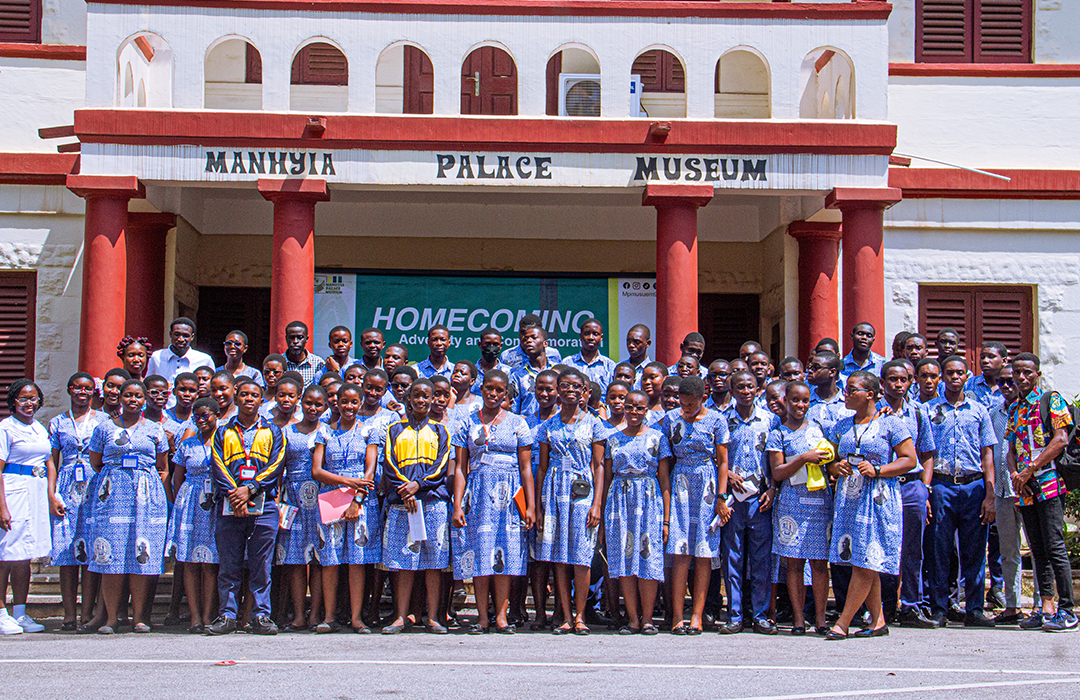
The ADF excursion held on Friday, 14th November 2025, was a fun and adventurous trip organized by St. Brother André Visual Arts Department to educate Visual Arts, Home Economics, and Science students who study Arts and Design Foundation.

The department chose to tour one of the largest and most culturally rich regions in Ghana. The selected sites were Manhyia Palace Museum, Kwame Nkrumah University of Science and Technology Department of Ceramics and Bonwire Kente Weaving Centre in the Ashanti Region.
The team set off at exactly 2:00 a.m. from the campus of Brand High School. By 10:00 a.m, they arrived at the gates of the Manhyia Palace Museum. The museum is filled with significant artworks that embody both Ghanaian and Asante history. Students learned about the Ancient Indian Rubber Tree located on the museum grounds, the World Peace Bell created in memory of Kofi Annan, the Asante porcupine emblem and many other historical artefacts.

The museum, opened in 1995, was formerly the residence of Asantehene Agyeman Prempeh I from 1921 to 1931 after his return from British exile in Seychelles. It commemorates the 150th anniversary of his return and serves as a preservation site for Asante cultural heritage.
Inside the museum are sculptures of both ancient and contemporary leaders of the Asante Kingdom, including Prempeh I, Opoku Ware, Otumfuo Osei Tutu II, Yaa Asantewaa and Nana Konadu Yiadom III, the late Asantehemaa (Queen Mother).

From Manhyia, the team proceeded to Kwame Nkrumah University of Science and Technology, specifically the Ceramics Department. There, students toured the facility and were taught about the various raw materials used in producing beautifully molded ceramic items for both social and domestic use. They were also taken through the step-by-step process of creating ceramic products, from the preparation of clay to molding, firing and glazing.

Their last and final destination in the Ashanti Region was Bonwire, specifically the Bonwire Kente Weaving Centre.

Kente is a meaningful sartorial art form, as every aspect of its aesthetic design communicates a message. The colors of the cloth each carry symbolic meanings: gold represents status and serenity, yellow signifies fertility, green stands for renewal, blue symbolizes pure spirit and harmony, red represents passion, and black signifies union with ancestors and spiritual awareness. The Bonwire Weaving Centre has over fifty skilled kente weavers, each with a unique signature style. The students learned a lot about the advantages and challenges of the weaving profession. Some even attempted to try their hands at weaving, and surprisingly, many of them succeeded on their first try.
